Why I Stopped Obsessing Over Construction and Started Trusting Gesture
In graphic novels, gestural drawing work better than constructed ones to create atmosphere, mood and liveliness. In this blog post you'll find ways to achieve this.
6/24/20266 min read
Why I Stopped Obsessing Over Construction and Started Trusting Gesture
For a long time, I thought construction was the missing piece.
Like many aspiring comic artists, I believed that if I could just master anatomy, perspective, and figure construction, everything else would fall into place. Every awkward pose, every failed panel, every drawing that didn't match the image in my head seemed to point to the same conclusion:
You need more structure.
So I studied structure.
I learned perspective grids. I built mannequins. I broke the body down into boxes, cylinders, and simplified forms. I spent hours trying to understand how figures occupied three-dimensional space.
And to be fair, construction did give me something valuable: confidence.
For the first time, I felt like I understood why things looked the way they did. Instead of blindly copying references, I began to understand the mechanics behind them.
But there was also a problem.
Actually, several problems.
The Frustrating Side of Construction
The promise of construction is seductive.
Learn the underlying structure, and you'll be able to draw anything from imagination.
At least, that's what I thought.
The reality was more complicated.
The more I focused on construction, the more my drawings started to feel:
stiff
angular
mechanical
overworked
unnatural
Instead of drawing people, I was drawing systems.
Instead of capturing movement, I was assembling objects.
Ironically, the drawings often looked less alive than before.
Construction worked reasonably well when I was copying a reference. It helped me understand perspective and proportions. It helped me analyze what I was seeing.
But when I tried to create scenes from imagination, something strange happened.
The life disappeared.
The image in my head felt dynamic and cinematic.
The drawing on paper felt engineered.
And that's not why I fell in love with graphic novels.
What I Loved Before I Learned Construction
Long before I knew anything about perspective systems or anatomical landmarks, I loved gesture drawing.
I wasn't particularly good or bad at it.
Most of my gesture sketches were messy. The proportions were often wrong. Limbs stretched too far. Heads became too small. Perspectives collapsed.
But they had something my carefully constructed drawings often lacked:
Life.
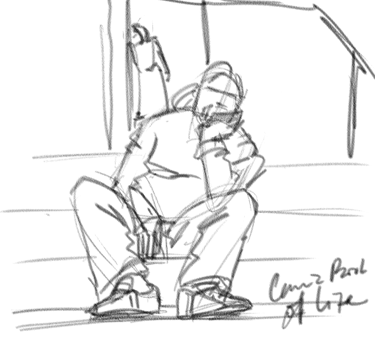
A gesture drawing leaves room for interpretation.
It suggests rather than explains.
It captures movement rather than mechanics.
And in many ways, that's exactly what graphic novels do.
Readers don't experience a graphic novel the way they experience a technical illustration.
They aren't measuring proportions.
They aren't checking perspective accuracy.
They're filling gaps with their imagination.
They're participating in the story.
The most memorable graphic novel panels often leave things unsaid.
They hint.
They suggest.
They invite.
As a young artist, I instinctively loved that quality.
Then I spent years trying to draw it out of myself.
The Moment I Realized What Was Wrong
Eventually I noticed a pattern.
A rough thumbnail would look great.
Not polished.
Not technically perfect.
But alive.
The pose had energy.
The composition had rhythm.
The atmosphere was already there.
Then I would begin refining it.
My process usually looked something like this:
Correct the anatomy.
Improve the perspective.
Fix proportions.
Clarify forms.
Add construction.
Refine contours.
And somehow, somewhere during that process, the drawing would die.
Not literally, of course.
It would become more accurate.
But it would also become less interesting.
Less emotional.
Less cinematic.
Less alive.
I eventually realized that my problem wasn't a lack of technical knowledge.
My problem was that I had started treating technical knowledge as the goal instead of the tool.
Construction Is a Foundation, Not a Performance
At some point, I stopped asking myself whether a drawing was correct.
Instead, I started asking a different question:
Does it feel the way I felt when I first imagined it?
That sounds simple, but it completely changed the way I draw.
When I picture a scene in my head, I don't see perspective grids. I don't see ribcages, cylinders, or vanishing points.
I see fragments.
A figure leaning into the rain.
A face half-hidden in shadow.
A hand reaching toward a door.
The glow of a streetlamp.
A silhouette disappearing into fog.
The image arrives as a feeling long before it arrives as a technical problem.
Yet for years, the moment I started drawing, I would translate that feeling into construction. Almost immediately, the emotional image became an engineering challenge. Instead of asking what the scene needed, I started asking what the anatomy needed.
The result was often technically better and artistically worse.
Looking back, I think I misunderstood the role of construction.
Construction is important, but it should work like grammar in a novel. A reader notices bad grammar immediately, but nobody reads a great novel because the commas are perfectly placed.
The same is true for drawing.
Readers don't fall in love with a graphic novel because the perspective is flawless. They fall in love with it because the images create a world they can step into.
Construction helps build that world.
It isn't the world itself.
Learning to Trust What Happens First
One thing I've noticed over the years is that my first instinct is usually closer to the final image than I think.
Not more accurate.
But more alive.
When I make thumbnails, there is very little hesitation. Shapes appear quickly. Decisions happen instinctively. The drawing isn't burdened by the need to be impressive.
It's just trying to communicate something.
Sometimes I'll look at a thumbnail and think, This works.
Then I spend two hours refining it.
Afterward, I look back at the original thumbnail and realize it contained something the finished drawing lost.
Not detail.
Not accuracy.
Energy.
That discovery was both frustrating and liberating.
Frustrating because it meant I had been sabotaging myself.
Liberating because it suggested a different goal.
Maybe the purpose of the finished drawing isn't to improve the thumbnail.
Maybe it's to preserve what made the thumbnail work in the first place.
What Graphic Novels Actually Need
I think this realization became clearer as I studied the artists I admire most.
When I look at their work, I'm often struck by what they leave out.
A shoulder becomes a brushstroke.
A face dissolves into shadow.
An entire background is suggested with a handful of marks.
There is an enormous amount of trust in the reader.
Trust that the reader will complete the image.
Trust that suggestion can be stronger than explanation.
Trust that atmosphere can carry information that detail cannot.
As artists, we often feel responsible for drawing everything.
But graphic novels don't work because everything is shown.
They work because the reader is constantly participating.
Every panel is a collaboration between artist and audience.
The reader fills in the missing motion between panels.
The reader invents sounds.
The reader imagines textures.
The reader completes faces hidden in shadow.
In a strange way, the things we leave out are often as important as the things we draw.
The Most Valuable Skill Isn't Accuracy
If I could go back and give advice to my younger self, I probably wouldn't tell him to study less perspective.
Perspective matters.
Anatomy matters.
Structure matters.
But I would tell him that those things are only part of the equation.
The harder skill is learning how to retain emotion while applying them.
How to keep a pose alive while correcting it.
How to preserve mystery while clarifying forms.
How to make decisions without over-explaining them.
Those skills don't show up easily in tutorials.
They're developed through repetition.
Through experimentation.
Through making thousands of drawings that don't quite work.
And through noticing that sometimes the mistakes are carrying more life than the corrections.
Returning to Why I Started
The funny thing is that after all these years, I feel as though I've returned to something I understood intuitively at the beginning.
Back when I was making messy gesture drawings.
Back when proportions were wrong and perspectives collapsed.
Back when I didn't know enough to overthink every mark.
Those drawings weren't better.
But they contained something important.
They invited the viewer to participate.
They left room for imagination.
And isn't that what graphic novels are ultimately about?
Not displaying technical mastery.
Not proving that we understand anatomy.
But creating images that linger in someone's mind long after the page has been turned.
These days, whenever I find myself obsessing over whether a drawing is correct, I try to pause and ask a different question:
Is this becoming more alive?
If the answer is yes, I keep going.
If the answer is no, I know exactly what to do.
I stop refining.
I loosen my grip.
And I start drawing again.